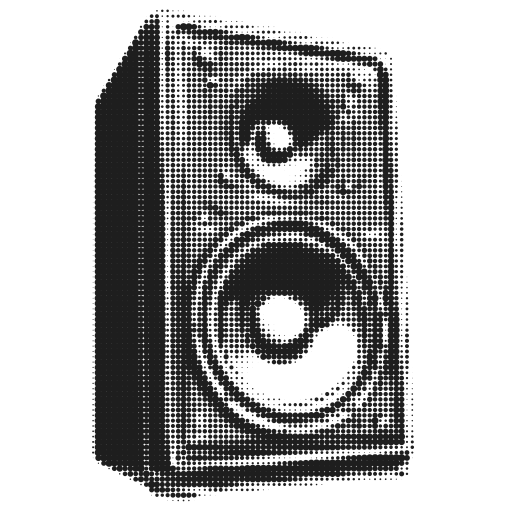
Progressive house
Progressive House
[edit]Progressive house is a subgenre of house music that emerged in the United Kingdom in the early 1990s. It is characterised by gradual melodic build-ups, layered synthesiser textures, extended track lengths, and a sense of emotional progression across a DJ set or album. While rooted in the four-on-the-floor rhythms of American house music, progressive house incorporated influences from trance, techno, ambient and Eurodance, resulting in a distinctly British sound that dominated European club culture through the mid-to-late 1990s.
Origins of the Term
[edit]The word "progressive" has a long history in popular music. It was first widely applied in the 1970s to describe progressive rock — music that incorporated classical structures, extended composition, and high production values. In Detroit in the early 1980s, producer and DJ Carl Craig recalled the term being used to describe Italo disco, referring to its European, Giorgio Moroder-influenced character as opposed to the soulful Philadelphia-rooted disco of the previous decade.
In the late 1980s, UK music journalist Simon Reynolds applied the label "progressive dance" to acts such as 808 State, The Orb, Bomb the Bass, and The Shamen — artists working at the intersection of house, psychedelia, and electronic experimentation. By 1990–1992, the shortened form "progressive house" had crystallised into a specific genre designation within the British rave and club scenes.
The term entered the mainstream music press in 1992 when journalist Dom Phillips wrote a piece in Mixmag entitled "Trance Mission", describing a "new breed of hard but tuneful, banging but thoughtful, uplifting and trancey British house." This article is widely credited with formally naming the genre.
Early Development (1990–1993)
[edit]The earliest recognised progressive house recording is often cited as Leftfield's "Not Forgotten" (1990), released on the British label Outer Rhythm. The track blended driving house rhythms with dub basslines and atmospheric elements in ways that were difficult to classify, giving other British producers the confidence to experiment with similarly genre-blurring sounds.
Other early contributors included Bassomatic and The KLF, who brought an emphasis on dynamics, layered arrangements, and longer track durations to dance music. By 1992, the sound had begun to cohere around a recognisable aesthetic. Key records from this period include:
- Leftfield — "Not Forgotten" (1990)
- Gat Decor — "Passion" (1992)
- Leftfield — "Release the Pressure" (1992)
- Spooky — "Little Bullet" (1992)
- Sasha — "Appolonia" (1992)
Gat Decor's "Passion" in particular became one of the definitive documents of the early genre — an instrumental track built from slowly evolving synthesiser layers without anthemic hooks or vocal leads, relying entirely on tension and texture to carry its emotional weight.
Sound and Musical Characteristics
[edit]Progressive house is defined as much by what it avoids as by what it includes. Unlike Chicago house or Eurodance, it tends to reject anthemic choruses, rapid crescendos, and simple call-and-response vocal hooks. Instead:
| Element | Description |
|---|---|
| Beat structure | Four-on-the-floor kick drum, typically 120–138 BPM; swing and syncopation in hi-hats and percussion |
| Melodic layering | Harmonies and motifs that evolve gradually across the length of a track; phrases typically 4, 8, or 16 bars |
| Track length | Commonly 8–12 minutes in club mixes; extended intros and outros designed for seamless DJ mixing |
| Atmospheric texture | Pads, string-like synths, reverb-heavy elements creating depth and mood |
| Vocal use | Vocals, when present, are often treated as textural or rhythmic elements rather than melodic leads |
| Dynamic structure | Intensity built by gradual addition and subtraction of sonic layers rather than sudden drops |
| Drum machines | Roland TR-707, TR-808, and TR-909 sounds central to the classic early aesthetic |
The Golden Era (1994–1999)
[edit]By the mid-1990s, progressive house had moved from the underground into the mainstream of British and European club culture. Venues such as Cream in Liverpool and Twilo in New York became synonymous with the sound. The compilation series became a primary format for the genre, with Sasha and John Digweed's Northern Exposure (1996) widely regarded as one of the greatest DJ mix albums ever released in any genre.
Key labels of this era included:
- Guerilla Records — early home of Leftfield and others
- Renaissance — home of the landmark Renaissance: The Mix Collection series
- Stress Records — run by Dave Seaman, a central figure in the genre's development
- Bedrock Records — founded by John Digweed; continued to release progressive and deeper sounds into the 2000s
- Deconstruction Records — home to Sasha's productions
The Global Underground series, launched in 1996, documented the genre's international spread, releasing city-specific mix CDs by artists including Sasha, John Digweed, Nick Warren, and Danny Howells, helping to define a global progressive house aesthetic.
Key Artists
[edit]| Artist | Role / Significance |
|---|---|
| Sasha | Widely considered the defining progressive house DJ; pioneering sets at Liverpool's Cream; Northern Exposure (with Digweed) regarded as landmark of the genre |
| John Digweed | Long-running creative partner of Sasha; founder of Bedrock Records; known for dark, cinematic DJ sets |
| Leftfield | Pioneers of the early sound; "Not Forgotten" (1990) considered one of the first progressive house recordings |
| Gat Decor | Producers of "Passion" (1992), one of the genre's most enduring early classics |
| Dave Seaman | Former editor of Mixmag; founder of Stress Records; outspoken commentator on the genre's evolution and commercialisation |
| Nick Warren | Key figure in the mid-to-late 1990s scene; resident DJ at Bristol's legendary club Lakota |
| Hernán Cattáneo | Argentine DJ who became one of the foremost ambassadors of progressive house internationally into the 2000s |
| Danny Howells | Known for deep, rolling progressive sets; remained true to underground roots through the 2000s |
| Paul Oakenfold | Early influence blending house with trance elements; later moved toward a more commercial trance sound |
| deadmau5 | Brought progressive house sensibility to a global mainstream audience in the late 2000s; tracks like "Strobe" (2009) became defining of a new melodic approach |
| Eric Prydz | Known for meticulous production; his Pryda alias produced influential works that bridged progressive house and festival-oriented EDM |
Backlash and Decline (2000–2005)
[edit]By the early 2000s, progressive house had become a victim of its own success. The genre's original qualities — long track structures, emotional restraint, sophisticated layering — were increasingly imitated by producers who applied the format without the substance. Dave Seaman, one of the genre's originators, summarised the problem: the music had followed the same trajectory as progressive rock before it, becoming, in his words, "pompous, po-faced and full of its own self-importance."
The underground scene fragmented. Some DJs who had previously played progressive house began relabelling their output as tech house, techno, or deep house, reflecting how blurred the genre boundaries had become. Concurrently, a new wave of producers took the "progressive house" label in a more commercial direction, incorporating elements of Eurodance and uplifting trance that bore little relationship to the original 1992 sound.
Revival and Modern Forms (2010s–present)
[edit]Progressive house underwent a notable revival in the late 2010s, partly through the rise of a warmer, more organic substyle often marketed as melodic house or melodic house and techno. Artists including Lane 8, Ben Böhmer, Yotto, and Guy J drew on the emotional depth and gradual development of classic progressive house while incorporating modern production aesthetics and acoustic elements.
Labels that played key roles in the revival include:
- Anjunadeep — pioneered a melodic, introspective branch of progressive sound
- Bedrock Records — continued to bridge classic and contemporary progressive house
- Lost & Found — a significant platform for modern melodic progressive artists
The genre today sits at an intersection between melodic house, techno, and ambient dance music, and remains a favourite in both club environments and larger festival settings. Its core identity — the gradual unfolding of emotional intensity through layered sound design — has proven durable across more than three decades.
Relationship to Other Genres
[edit]Progressive house overlaps with and has influenced a number of related genres:
- Trance — shared melodic and atmospheric qualities in the early years; the two were often interchangeable labels until trance developed its own anthemic direction
- Tech house — took on much of the underground progressive audience in the 2000s
- Deep house — shares the introspective quality and attention to texture
- Melodic techno — the contemporary form most closely aligned with original progressive house values
- Ambient — influenced the use of pads, reverb, and atmosphere throughout
See Also
[edit]References
[edit]- Phillips, Dom (2009). Superstar DJs Here We Go!: The Rise and Fall of the Superstar DJ. Random House. ISBN 978-1-4070-2695-4.
- Reynolds, Simon (1998). Energy Flash: A Journey Through Rave Music and Dance Culture. Picador.
- Mixmag, "Trance Mission" (Dom Phillips, 1992).